
How Vibha Jha Won the US Investing Championship
Updated: Jan 11
The Strategy That Beat Everyone
Understanding Vibha Jha's Winning Strategy
Today, we will explore the methodology of one of the top performers in the U.S. Investing Championship (USIC): Vibha Jha. Through her hybrid approach to trading, Vibha achieved remarkable triple-digit returns in the money manager division. She managed over $1 million for two consecutive years (2020 and 2021) and delivered a respectable 70% return in 2023, followed by a stunning 78% return in 2024.
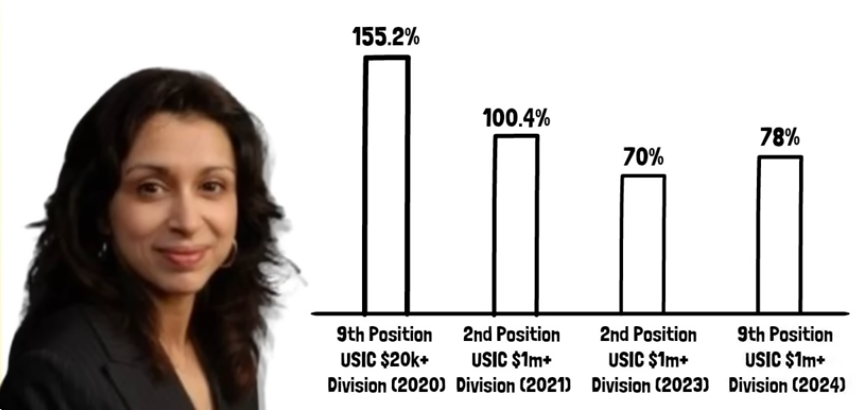
Vibha's consistency and exceptional returns stem from her extensive corporate experience, which she transformed into a robust hybrid trading system.
The CANSLIM Methodology
Vibha's success is particularly notable in her application of the CANSLIM methodology to positional trading. This is complemented by a highly effective, rules-based swing trading strategy utilizing the leveraged ETF, TQQQ.
While many traders advise sticking to one approach, either stock picking or trading ETFs, Vibha's strategy shows that the most successful traders adapt their methods to market conditions.
Vibha was a corporate executive at Aetna. She stumbled into trading after witnessing her account plummet by 80% during the dot-com crash. This devastating loss laid the groundwork for a methodology that would eventually compete against Wall Street's best.

Vibha's Core Philosophy
Before diving into her hybrid approach, it is essential to understand Vibha's core philosophy: she only wants to own true market leaders, companies with the potential to double or triple over 12 to 18 months.
In 2009, Vibha discovered the CANSLIM methodology through a newsletter that analysed its performance. The analysis revealed that CANSLIM had returned 35.2% per year over an 11-year period. This finding resonated with her long-term goal of trying to "triple or double" her money every three to five years. Realising that a 35% annual return could nearly double her capital every two years, she committed to mastering the system. She used the book “How to Make Money in Stocks” as her primary guide, alongside a temporary subscription to IBD (Investors Business Daily).
Screening Process
Her screening process begins with the IBD 50, Sector Leaders, and IPO Leaders. However, her trading approach extends beyond just fundamentals. Vibha insists on both fundamental excellence and technical setup alignment.

Fundamental Criteria
For fundamentals, she requires quarterly earnings and sales growth of 25% or higher, ideally preferring 30% to 35% or more. She pays particular attention if earnings exceed 70%. High ratings in EPS, Composite, and RS ratings generally above 95 are also crucial. Additionally, she looks for increasing institutional support, indicated by accumulation/distribution ratings and the number of funds involved.

Technical Analysis
While fundamentals help identify suitable trading candidates, entries are always based on technicals. Vibha uses weekly charts for overall direction but executes buys using daily charts. She prefers to enter when a stock emerges from a Stage 1 or Stage 2 base, often favouring classic bases like the cup with handle and double bottoms. Her goal is to buy when the stock is retaking the 50-day or 10-week moving average, ideally making higher lows.

Here is how Vibha sizes her trading positions:
She generally initiates a position with no more than 10% of her portfolio and aims to hold six to eight individual stocks. To time her trades effectively, she avoids buying too close to earnings reports, typically waiting until after earnings have been released unless the report is at least a month away.
She adds to existing positions (up to 12.5% to 15% total position) when the stock bounces off the 50-day/10-week moving average for the first time or forms its first three-weeks-tight pattern.

Risk Management
Vibha realised that the most significant improvement to her performance came from limiting losses. She employs a technical stop-loss rather than a rigid 7-8% numerical stop. Her stop is set based on the 10-week or 50-day moving average. When she buys, she aims to be within 8% of that technical stop-loss level.

Exit Strategies
For profitable positions, Vibha has multiple exit rules:
Moving Average Violation: She will sell if the stock severely undercuts the 10-week moving average or the 50-day moving average. If the stock does this and she has already achieved her desired gain, she is "out for sure".
Gap Down: A significant gap down, such as a 20-something percent drop, often caused by earnings, is a clear technical sell signal, prompting her to exit immediately.
Vibha's longer-term, 12-to-18-month holding period also means she exits based on changes to the underlying business:
Loss of Conviction: She will exit sooner if the business strategy changes, leadership shifts, or if she loses conviction in the company.
Weaker Holdings: When the overall market shows signs of a deeper correction, she will sell her weaker performers first to reduce exposure.
Quarterly Review Process
Vibha utilises a quarterly review process to ensure efficient capital allocation. During this review, she will sell a stock that has achieved a good gain (say a 70% return) if she has her eye on a new investment on her A-list that she believes has the potential for a higher return (say a 100% potential).
She tolerates pullbacks of 5% to 8% within the context of a larger uptrend, especially if the volume is low. Vibha often waits until the end of the week to see if things "smooth themselves out."
Pivoting to TQQQ
Here is the part that separates Vibha from most swing traders. When individual stock setups dry up, which happens regularly in choppy markets, she doesn't sit in cash. Instead, she pivots to swing trading TQQQ, a 3x leveraged ETF tracking the NASDAQ 100, with concentrated positions.

Merits of TQQQ Utilization
Tax Advantage: She uses TQQQ extensively in her IRA accounts because she does not have to worry about the tax implications of short-term gains.
Market Exposure and Leverage: The strategy originated when she found that many companies meeting her strict CANSLIM criteria were massive growth stocks (like the Magnificent Seven). Since these were already large, she felt they were less likely to double or triple quickly compared to smaller market leaders. TQQQ allows her to gain leveraged exposure to those strong names for oversized returns.
Market Entry Tool: When the market turns around after a deep correction, she uses TQQQ as her initial entry strategy, often entering around day four or five of a rally, even before a formal follow-through day. This ensures she is invested while taking time to find the best six to eight individual stock setups. Once she identifies those positions, she starts selling down the TQQQ to transition into the stocks.
Systematic Approach to TQQQ

Vibha's TQQQ strategy isn't random. She tracks specific metrics on a spreadsheet: percentage moves from peaks to troughs, the number of days for each swing, and volume characteristics. Over years of observation, she identified that TQQQ typically delivers 20-25% swings multiple times per year.
Position Sizing for TQQQ
Here's her systematic approach: She enters TQQQ positions when it gets close to the 50-day or 21-day moving average after a 10-15% pullback. She will initiate a buy as the price begins to turn around and make higher highs.

Vibha follows a different position sizing rule for TQQQ, generally initiating positions at 25% of her portfolio dedicated to TQQQ, sometimes going as high as 50%. In Roth accounts, she has sized positions up to 90% or 100%. She tries to maintain a 25% core position in TQQQ as long as the overall market remains in a long-term Stage 2 uptrend.
Exiting TQQQ Positions
For exits, TQQQ is a primary vehicle for selling into strength. Vibha aims to capitalise on moves of 20% or higher, contrasting with her defensive selling approach for individual positions. She tracks specific metrics, peaks, bottoms, and the duration of moves, to understand the pattern of TQQQ swings within the current market cycle.
Vibha employs a comprehensive checklist of specific, rules-based sell signals. She does not sell everything at once but sells in chunks (like 10% blocks) as multiple signals are triggered.
TQQQ Selling Checklist
New 52-Week High: She starts watching closely when TQQQ makes a new 52-week high, anticipating potential resistance or profit-taking.
Declining Volume on New Highs: New highs made with declining volume are viewed as a warning sign.
Distribution Days: When the NASDAQ index accumulates four to five distribution days, she becomes more aggressive in locking in gains.
10-Day Moving Average Violation: She sells if TQQQ gives up the 10-day moving average, especially if this occurs on rising volume.
Consecutive Down Days: If there are three consecutive down days in rising volume, this triggers a sell signal.
Resistance Rejection: If the price hits a known resistance level and gets rejected three times.
Poor Close/Volume: A poor close and rising volume below the 10-week moving average is also a key indicator.
Bulls versus Bears Index: When this index climbs above 60%, she considers this a secondary indicator that market sentiment is becoming "frothy".
Vibha emphasises that this strategy requires strict adherence to rules, as TQQQ is "very ugly on the way down". If she enters early during a rally, she manages risk by exiting immediately if the price undercuts the low of the rally day.

Decision-Making Between Stocks and TQQQ
The million-dollar question is: how does she decide between individual stocks and TQQQ?
Individual stocks take priority when three conditions align: a strong market environment with minimal distribution days, multiple stocks meeting her fundamental criteria appearing on IBD lists, and clear technical setups with proper base formations.
TQQQ becomes the focus when individual setups are scarce, the market is emerging from a correction but individual stocks haven't formed proper bases yet, or when she needs liquidity to capture shorter-term market swings without tax implications in retirement accounts.

Performance Insights
A crucial insight from her 2023 performance is that seven of her ten individual stock trades were losers. However, her overall return was still impressive because the three winners were four times larger than the combined losses. Meanwhile, TQQQ swing trading provided consistent 20-25% gains multiple times throughout the year, contributing significantly to her 2023 returns.
This reveals the psychological advantage of the hybrid approach: when individual stock picking becomes frustrating, TQQQ provides a reliable alternative that keeps traders engaged with the market rather than sitting in cash.

Most importantly, Vibha's strategy acknowledges that markets change. The same strategy that works brilliantly in trending markets might fail in choppy conditions. By having two complementary approaches, traders can adapt to whatever market environment emerges.
Key Insights
The key insights are to focus on true market leaders when individual setups are available, pivot to TQQQ when they're not, size positions according to conviction and time horizon, and maintain systematic risk management for both approaches.
Remember, Vibha achieved these results without margin except for the default leverage in TQQQ. This proves that proper strategy and risk management matter more than leverage. Her success in the US Investing Championship demonstrates that individual traders can compete with professional money managers when they develop systematic, adaptable approaches.
And if you're serious about improving your trading results, grab your free copy of my strategy PDF using the link below. It contains my complete framework for identifying leading stocks and timing your entries using low-risk entry points and taking timely exits for maximum profit potential.
For those interested in using my breakout method and bespoke scanner, why not join us: https://www.financialwisdomtv.com/service

FREE E-Book Click Here - Professional Swing Trading Platform - Award Winning Swing Trader
Related Reading
Inside the Financial Wisdom Weekly Consolidation Breakout Framework
Risk Management in Trading: The Foundation of Long-Term Profitability
Published by FinancialWisdomTV.com Rules-Based Breakout Trading | Probability-Driven Execution | Long-Term Market Education


Comments