
The Truth About Stock Valuations Tesla, Palantir, NVIDIA etc
Updated: Jan 5
Valuations Explained: Why “Expensive” Stocks Can Still Be the Best Trades
Do valuations matter that much?
Valuation is the process of estimating what a stock is worth, but its relevance depends entirely on your trading or investing style. This article explains the three main valuation methods, why price and value often diverge, and why relying on traditional valuation metrics alone can cause traders to miss some of the market’s biggest winners. You’ll also learn why momentum-driven strategies often outperform valuation-led approaches during strong growth cycles.
Introduction

In today’s video, we discuss valuations, what they are, how investors use them, and why they often divide opinion in stock trading and investing.
Valuation is a complex and highly subjective concept. Its perceived importance varies not only between investors, but also across different market environments.
To understand why, consider a simple real-world example.
Price vs Value: The Coke Analogy
Imagine buying a can of Coke from a discount store versus ordering the same Coke in a luxury hotel room.
Both drinks quench your thirst in exactly the same way. Yet the hotel Coke might cost several times more. The difference in price reflects context and service, not the product itself.
Some people are happy to pay the premium for comfort and convenience. Others see no justification and would rather buy the cheaper Coke and drink it in the hotel room anyway.

This same dynamic plays out every day in the stock market.
A buyer and seller agree on a transaction price, but their perception of value can be completely different. The buyer believes the stock is undervalued and will rise.
The seller believes it is overvalued and chooses to exit.
When Valuation Fails: The Palantir Example

A recent example of valuation disagreement was Palantir.
In August 2024:
Palantir traded on a PE ratio of 70
The average PE for tech stocks in the S&P 500 was 28
Stockopedia assigned it a value score of 2/100
By conventional valuation standards, Palantir looked extremely expensive.
At the start of August, the stock traded around $30. Just four months later, it had surged to $80, and its PE ratio expanded to 170.
Any investor relying solely on traditional valuation metrics would have missed a nearly 3x move.
This is a recurring theme in growth and momentum stocks, and one of the main reasons valuations are not central to my trading approach.
The Three Main Valuation Methods
Although valuations are not the primary driver of my strategy, they remain foundational for many investors. Broadly, there are three main valuation approaches.
1. Asset-Based Valuation
The asset-based method values a company using its Net Asset Value (NAV):
Assets – Liabilities = Net Asset Value
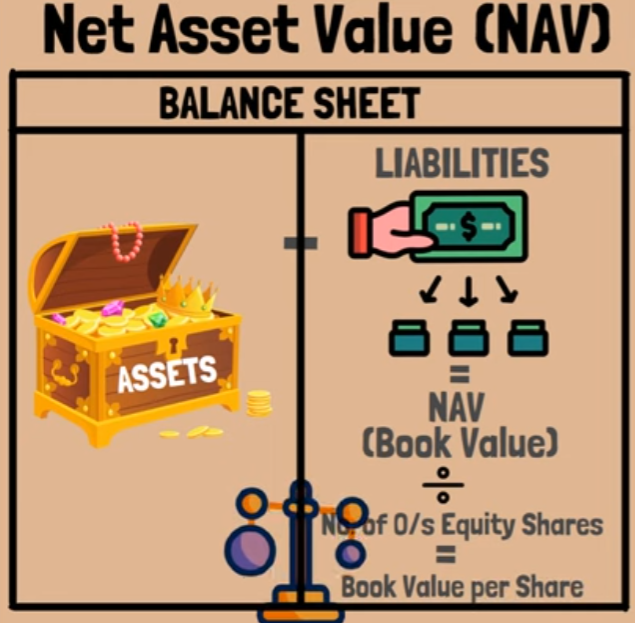
When divided by the number of outstanding shares, this produces the book value per share.
This leads to the Price-to-Book (PB) ratio:
PB < 1 → trading below book value
PB > 1 → trading above book value
Value investors often search for stocks trading below book value, expecting prices to eventually converge with intrinsic worth.
Warren Buffett built much of his early success buying companies trading at or below their book value.
2. Income-Based Valuation
The income-based approach values a stock based on discounted future cash flows or earnings.
For example:
A company paying $5 per share in perpetuity
Discounted at 10%
Implies a valuation of $50 per share

This method accounts for risk via the discount rate:
Higher risk → higher discount rate → lower valuation
Lower risk → lower discount rate → higher valuation
Valuations also fluctuate with market sentiment. During risk-averse periods, discount rates rise and valuations fall. In optimistic markets, investors accept lower risk premiums.
3. Market-Based Valuation
This method compares a stock’s metrics to industry peers.

The most common metric is the Price-to-Earnings (PE) ratio, but others include:
Price-to-Sales
Price-to-Cash Flow
Price-to-Operating Profit
If a company trades at a lower multiple than its peers, it may appear undervalued, though this often ignores growth, quality, and momentum.

Price and Value Are Not the Same Thing
The difference between price and value is critical.

Benjamin Graham explained this through his famous “Mr Market” analogy. Mr Market is emotional sometimes pessimistic, sometimes euphoric. He offers stocks cheaply during fear and expensively during excitement.
Value investors thrive during pessimistic phases when prices fall below intrinsic value. During euphoric markets, however, valuations often expand far beyond what traditional models justify.
Growth Stocks and the Limits of Valuation
In recent decades, valuation metrics have struggled to explain the success of many transformational companies.

Examples include:
Amazon
Tesla
Uber
Biotech innovators
These companies often traded at high valuations long before profitability, driven by future potential, not present earnings.
Tesla: Another Valuation Trap
In August 2024:
Tesla traded on a PE ratio of 76
Stockopedia gave it a valuation score of 5/100
The stock appeared expensive by every traditional metric
Yet Tesla was growing revenues at a 35% CAGR.
At the time, the stock traded near $206. Just over four months later, it had climbed above $450.

Once again, valuation-focused investors were left watching from the sidelines.
How Valuation Fits (or Doesn’t) Into My Strategy
In my own trading approach, valuations take a backseat.
I focus on:
Quality (ROE, margins, growth, balance sheet strength)
Momentum (stocks already trending higher)
Technical structure (breakouts from consolidation)
High-quality momentum stocks often look “expensive” on paper, but strong growth frequently justifies the premium.

Conversely, many undervalued stocks are cheap for a reason. Structural headwinds can keep them depressed for years. While some investors excel at turning these into winners, it’s not my edge.
My edge lies in identifying quality stocks already being accumulated and riding the trend.
When Valuations Matter More
Valuations tend to matter more:
In slow-growth or mature industries
During bear markets and risk-off environments
When liquidity tightens and investors demand higher risk premiums
In strong bull markets, momentum and growth often dominate valuation considerations.
Final Thoughts
Valuations are neither useless nor universally decisive.
For value investors, they are the foundation of decision-making. For momentum traders, they are often secondary to trend, growth, and institutional demand.
Understanding when valuations matter—and when they don’t—is the real edge.
For those looking to follow my trades, use my scanner, or join our group of like-minded traders, you’ll find the links below.
If you want to go deeper:
Download the Free strategy PDF
Explore the Bespoke breakout scanner
Join the group where I share trades, portfolio management, and execution logic in real time
Those interested in a structured, rules-based approach can explore the Financial Wisdom Strategy Blueprint, available free, which outlines a complete framework refined over decades.


Performance:

Related Reading
Inside the Financial Wisdom Weekly Consolidation Breakout Framework
Risk Management in Trading: The Foundation of Long-Term Profitability
My Brokerage Account (Interactive Brokers) - https://bit.ly/3UGvn1U


Comments