
Building Winning Algorithmic Trading Systems: Kevin Davey’s Complete Framework for Trading Success
How a World Trading Champion Built Systematic Strategies That Delivered Triple-Digit Returns and How You Can Apply the Same Process
Summary:
In this article, we break down the methodology from Kevin J. Davey’s book Building Winning Algorithmic Trading Systems. Kevin transformed himself from a struggling trader who suffered multiple account blowups into a World Cup Championship of Futures Trading winner, posting returns of 148%, 107%, and 112% in consecutive years.
The framework follows a structured seven-step process: setting SMART goals, developing a trading edge, conducting feasibility testing, performing walk-forward analysis, stress testing with Monte Carlo simulations, incubating strategies in real-time, and finally deploying diversified systems with disciplined position sizing.
Whether you trade manually, systematically, or fully algorithmically, this framework provides a practical blueprint for building robust trading systems capable of surviving real-world market conditions whilst avoiding common pitfalls such as over-optimization and emotional decision-making.
Download our FREE trading strategy for the approach I have used for decades:

Who Is Kevin J. Davey?
Kevin J. Davey is a professional trader, system developer, and author best known for his success in the World Cup Championship of Futures Trading.
Over three consecutive years, he achieved remarkable returns of:
148%
107%
112%

These results weren't achieved through intuition or discretionary trading. They came from a systematic, rules-based approach to building and executing trading strategies.
What makes Davey's story particularly compelling is that he didn't start as a successful trader.
Like many traders, he experienced painful losses along the way.

He lost 60% of an account trading moving averages, suffered a $70,000 loss averaging down into losing positions, and endured multiple account blowups before eventually becoming a trading champion.
His success was built on perseverance, structured testing, and relentless refinement of his systems.
Why Algorithmic Trading Appeals to Serious Traders
The biggest challenge in trading is often not finding opportunities.
It's consistently executing them.
Human emotions introduce problems such as:
Fear
Greed
Revenge trading
FOMO
Second-guessing
Algorithmic trading attempts to eliminate these issues by replacing discretionary decision-making with predefined rules.
Every entry, exit, stop loss, and position size is determined before the trade occurs.
The result is a process that can be tested, measured, refined, and repeated.
Kevin Davey's Seven-Step Strategy Factory
According to Davey, successful trading systems follow a structured development process he calls the Strategy Factory.
Let's examine each stage.
Step 1: Set SMART Trading Goals

Most traders begin with vague objectives such as:
Make money
Beat the market
Become a full-time trader
Davey takes a different approach.
Every goal must be:
Specific
Measurable
Achievable
Relevant
Time-bound
For one of his Euro futures systems, his goals included:
50% annual return
Maximum 25% drawdown
Win rate on 55% of trading days
Maximum of two trades per day
Strategy completed within one month
Every objective is quantifiable.
This removes ambiguity from the development process.
Step 2: Find a Trading Edge
Every profitable system begins with a logical reason for making money.
This is known as the edge.

Examples include:
Mean Reversion
Markets occasionally move too far from their average value.
Mean reversion systems bet on prices returning toward equilibrium.
Trend Following
Markets often continue moving in the same direction.
Trend-following systems attempt to capture sustained moves.
Breakout Trading
This is the approach I personally use.
Breakout systems attempt to identify periods when price escapes consolidation and begins a new trend.
The objective is not perfection.
The objective is positive expectancy.
For example:
Winning 50% of trades
Average winner 3x average loser (risk to reward Ratio)
Over time, that combination produces profitability.
Step 3: Conduct Feasibility Testing

Once the idea exists, Davey performs limited testing.
Importantly, he doesn't test decades of data immediately.
Instead, he begins with a small sample.
Typically:
One year
Two years
This phase is broken into three components.
Entry Testing
Does the entry provide an edge?

Examples:
Buy at breakout close?
Buy immediately on breakout?
Buy on retest?
Exit Testing
Exits often influence performance more than entries.
Questions include:
Exit on moving average cross?
Exit at specific profit target?
Exit at market close?
Core System Testing
Now entries and exits are combined.
The objective is simply to determine whether the strategy demonstrates potential.
At this stage perfection is unnecessary.
Davey simply wants evidence that the idea deserves further investigation.
The Danger of Over-Optimisation
This is where many traders fail.
A strategy can appear spectacular in a backtest.
Then completely collapse in live trading.
Why?
Because the system has been optimized to historical noise.
Davey refers to this as the optimisation trap.

Many traders unknowingly create systems that are perfectly designed for the past but incapable of adapting to the future.
Step 4: Walk-Forward Analysis
To combat over-optimisation, Davey performs walk-forward analysis.
This is arguably the most important part of the entire process.
Rather than optimize on all available data:
Optimize on a small section.
Test on unseen data.
Roll forward.
Repeat.
This process simulates real-world conditions.
It answers a critical question:
Can the strategy perform on data it has never seen before?
Many systems fail at this stage.
The few that survive become candidates for live trading.
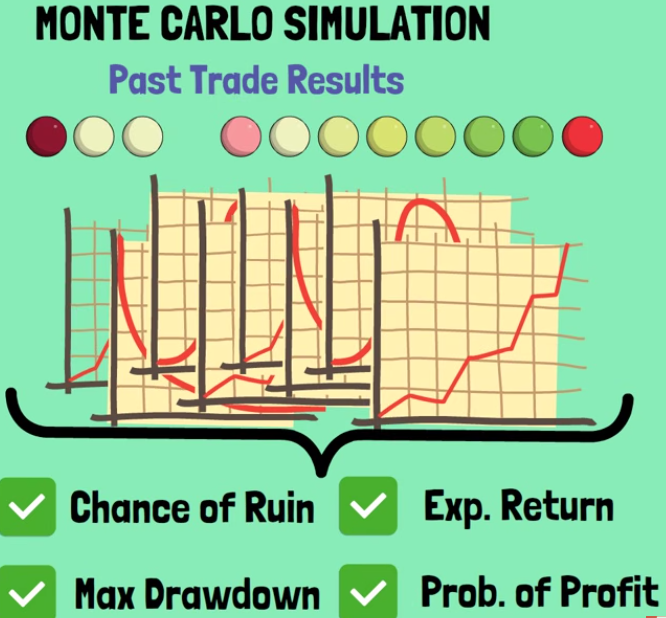
Step 5: Monte Carlo Simulation
Even robust strategies can experience unpleasant drawdowns.
Monte Carlo analysis helps estimate those possibilities.
The process shuffles trade outcomes thousands of times to create alternative equity curves.
From these simulations, traders can estimate:
Maximum drawdown
Probability of profit
Worst-case scenarios
Davey typically runs thousands of simulations before approving a strategy.
This helps prevent unrealistic expectations.
Step 6: Strategy Incubation

Many traders skip this stage.
Davey insists it is mandatory.
The strategy is placed into a live environment without risking capital.
Typically for:
Three months
Six months
During incubation, the trader compares live results with backtested expectations.
If the system behaves as expected, confidence increases.
If it doesn't, further investigation is required.
This step acts as a bridge between testing and live deployment.
Step 7: Live Trading, Position Sizing and Diversification
Once a strategy passes every previous stage, it becomes eligible for real capital.
However, Davey still applies additional safeguards.
Diversification
Rather than relying on one strategy, he combines multiple uncorrelated systems.
Examples include:
Different markets
Different timeframes
Different trading logic
This smooths equity curves and reduces risk.
Position Sizing
Position sizing determines:
How much capital to risk
How many contracts to trade
How aggressively to compound
Davey often uses fixed fractional position sizing to maximise returns while controlling risk.

Quitting Point
Every strategy receives a predefined stop-trading threshold.
For example:
Stop trading after a $5,000 drawdown per contract.
This prevents catastrophic losses if the strategy stops working.
Kevin Davey's Euro Trading System
One of the best examples from the book is Davey's Euro futures system.
Rather than relying on a single strategy, he developed two complementary systems.
Euro Night Strategy
Designed for overnight trading.

Characteristics:
Reversal based
Mean-reverting
High win rate
Frequent small profits
Euro Day Strategy
Designed for active US market hours.
Characteristics:
Trend aligned
Mean-reversion entries
Larger winners
Primary profit driver
The combined system produced significantly better results than either strategy individually.
This demonstrates the power of diversification.
By combining multiple edges, overall performance improved dramatically.

The Psychology of Algorithmic Trading
Many traders assume algorithmic trading eliminates emotions.
Davey argues otherwise.
The emotions simply change.

Instead of fear during trades, traders experience:
Fear during drawdowns
Temptation to skip signals
Desire to modify systems
Urges to interfere with execution
His solution is simple:
Write the rules before emotions appear.
Then follow them.
No exceptions.
No improvisation.
No second-guessing.
Why Learning to Code Matters
Davey strongly encourages traders to learn coding themselves.
There are two major advantages:
Protect Your Intellectual Property
The strategy remains yours.
You don't need to share proprietary ideas with developers.
Faster Development
Testing, modifications, and improvements become significantly quicker.
Modern tools make coding more accessible than ever.

Whether using:
Python
TradeStation
EasyLanguage
Pine Script
The barrier to entry is lower than many traders realise.
Final Thoughts
Kevin Davey's framework offers one of the most practical roadmaps available for developing trading systems.
His process forces traders to:
Define objectives
Validate ideas
Avoid over-optimisation
Test robustness
Execute consistently
Most importantly, it emphasises something many traders ignore:
A strategy is only as good as its ability to survive real-world conditions.
Over the years, I unknowingly followed many of the same principles whilst building my own rules-based breakout strategy. Although my approach isn't fully algorithmic, it follows strict rules regarding entries, exits, risk management, and position sizing. That consistency is what ultimately allows a strategy to become scalable, repeatable, and profitable over the long term.
The lesson from Kevin Davey's journey is simple:
Success in trading rarely comes from finding a magical indicator.
It comes from building a process that can withstand uncertainty, drawdowns, and the test of time.
Frequently Asked Questions
Who is Kevin J. Davey?
Kevin J. Davey is a professional trader, algorithmic system developer, author, and World Cup Championship of Futures Trading winner.
What is algorithmic trading?
Algorithmic trading uses predefined rules and computer code to execute trades automatically without emotional decision-making.
What are SMART goals in trading?
SMART goals are Specific, Measurable, Achievable, Relevant, and Time-bound objectives used to guide strategy development.
What is a trading edge?
A trading edge is a statistically proven advantage that gives a strategy a positive expectancy over a large sample of trades.
What is walk-forward testing?
Walk-forward testing optimizes a strategy on one data set and then tests it on unseen data to validate robustness.
Why is Monte Carlo analysis important?
Monte Carlo simulations help estimate drawdowns, risk of ruin, expected returns, and worst-case performance scenarios.
What is strategy incubation?
Incubation is a period where a strategy runs on live market data without real money to verify performance before deployment.
Why do trading systems fail?
Most systems fail due to over-optimization, changing market conditions, poor risk management, or lack of discipline.
What is fixed fractional position sizing?
It is a method of increasing or decreasing position sizes based on account equity and predefined risk parameters.
Can discretionary traders benefit from algorithmic principles?
Yes. Even manual traders can improve consistency by applying systematic rules, testing procedures, and risk management frameworks.
If you want to see our stock trading approach built on similar approaches.:
For more on the Financial Wisdom approach:
Download the Free strategy PDF
Explore the Bespoke breakout scanner
Join the group where I share trades, portfolio management, and execution logic in real time
Those interested in a structured, rules-based approach can explore the Financial Wisdom Strategy Blueprint, available free, which outlines a complete framework refined over decades.

Related Reading
Inside the Financial Wisdom Weekly Consolidation Breakout Framework
Risk Management in Trading: The Foundation of Long-Term Profitability
Published by FinancialWisdomTV.com Trading Education | Risk Management | Trading Psychology


Comments